
Uneven roasting is one of the most persistent quality defects in commercial peanut processing. It manifests as a batch with mixed color grades—some kernels pale and underdeveloped, others dark and over-roasted—which directly impacts product consistency, shelf life, and customer acceptance.
Factor 1: Equipment Type and Heat Distribution Design
The type of peanut roaster machine directly determines the heat transfer mechanism and, consequently, the uniformity ceiling of the process.
Drum Rotary Roasters
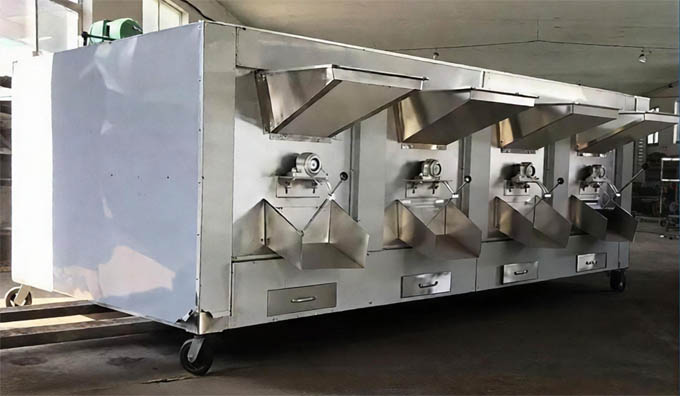
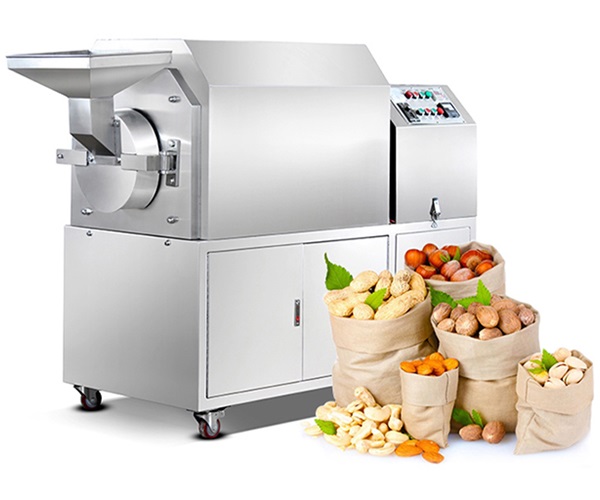
Drum roasters rely on a rotating cylinder combined with conductive and radiative heat transfer. The drum wall serves as the primary heat source, and the tumbling action redistributes kernels through the bed. The limitation is inherent to the design: if the drum surface has hot spots—areas where the heating elements run hotter or the drum wall is thinner—kernels contacting those zones will over-roast while others remain underdone. Industrial drum models typically offer adjustable temperature control from room temperature to 300°C and utilize heat conduction combined with heat radiation, but the reliance on wall contact means that drum temperature uniformity is the critical variable
Continuous Belt Roasters
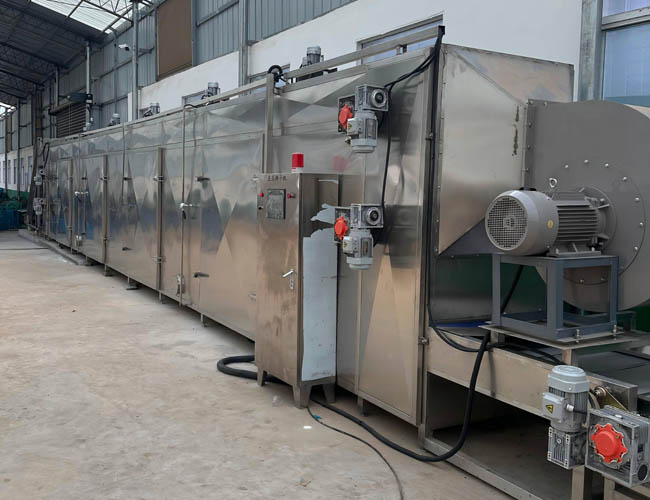
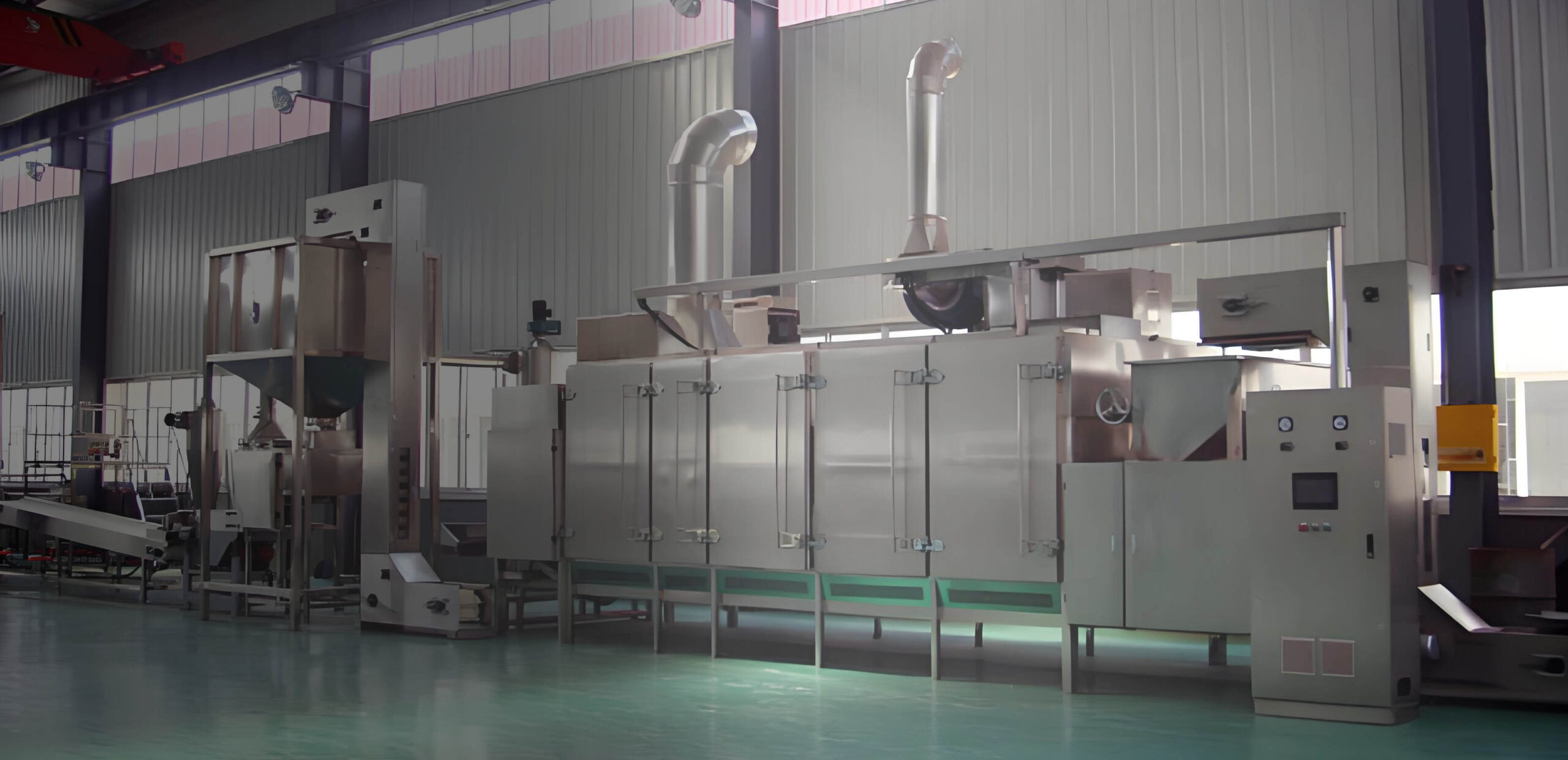
Continuous systems use forced convection—hot air circulated through a moving product bed—rather than direct wall contact. The design principle is sound: convective airflow through a permeable bed can, in theory, deliver uniform heat to every kernel. However, the product must be spread evenly across the belt. Uneven bed depth creates channeling effects, where air preferentially flows through thinner sections, leaving thicker areas under-roasted. Advanced continuous systems address this with multi-zone independent fans and burners, allowing operators to tailor airflow and temperature profiles across different stages of the roast .
Factor 2: Loading Capacity and Bed Depth
Batch size directly affects heat transfer efficiency and uniformity. Overloading a peanut roaster machine creates a bed so deep that heat cannot penetrate to the center before the outer layers begin to over-roast. Underloading, while less damaging to uniformity, wastes energy and reduces throughput.
The relationship between batch size and thermal response has been documented in related roasting research: larger batch masses exhibit slower rates of temperature change in the early stages of roasting, and the gap between surface and core temperatures widens as batch size increases . For peanuts specifically, this means that a drum rated for 100–600 kg per batch will produce noticeably different results at 100 kg versus 600 kg unless the operator adjusts temperature and time accordingly.
Practical guideline: Operate within 70–85% of rated capacity for the most consistent results. This provides sufficient bed depth for even heat distribution without overwhelming the system’s heat transfer capacity.
Factor 3: Temperature Control and the Uniformity Trade-off
Temperature is the most intuitive variable, yet its relationship with uniformity is often misunderstood. Lower temperatures produce more uniform color but require longer roast times. Higher temperatures shorten cycle time but amplify kernel-to-kernel variation.
The kinetic data confirms this: at elevated temperatures, the color development reaction accelerates, but the sensitivity to small temperature differences across the bed also increases . A 5°C variation across the roasting chamber that would be negligible at 150°C becomes a significant source of inconsistency at 200°C.
For operators seeking to optimize a peanut roaster machine for both throughput and quality, the practical approach is to identify the lowest temperature that achieves the target color within an acceptable cycle time, rather than defaulting to maximum temperature. Temperature control accuracy of ±2% is achievable in modern equipment, but the sensor placement must represent the actual product environment—not just the air temperature near the heating element .
Factor 4: Kernel Variation and Moisture Content
Even with perfect equipment and process control, incoming raw material variability affects roasting uniformity. Peanuts with different initial moisture contents, sizes, and testa (skin) conditions will respond differently to the same roasting profile. Research has shown that grains with higher initial water content experience greater mass loss during roasting, and the thermal load on the system increases correspondingly .
For processors receiving peanuts from multiple suppliers or harvest periods, moisture content screening before roasting is a low-cost intervention that significantly improves consistency. Target a narrow moisture range (typically 5–7% for dry roasting) and adjust roast profiles when incoming material deviates from that range.
Solutions: A Practical Protocol for Uniform Roasting
Achieving consistent results requires addressing equipment, process, and monitoring simultaneously.
1. Verify heat distribution before production. Conduct a thermal mapping test—place calibrated thermocouples at multiple points in the roasting chamber (inlet, center, outlet, and near walls) and run the machine empty at production temperature. Identify any zones exceeding ±5°C variation. For drum roasters, check drum surface temperature at multiple points. For continuous roasters, measure air velocity and temperature across the belt width.
2. Establish and enforce a loading protocol. Measure batch weights rather than relying on volume estimates. For drum roasters, mark the drum or use a weigh hopper. For continuous systems, calibrate the feed rate against belt speed and bed depth targets.
3. Optimize the temperature-time profile for uniformity first, throughput second. Start at the lower end of the recommended temperature range (typically 150–170°C for dry roasting) and extend time as needed. Once uniformity is achieved, test incremental temperature increases of 5°C, evaluating both color consistency and throughput gains.
4. Implement in-process monitoring. Visual inspection alone is insufficient for detecting early-stage unevenness. Sample from multiple locations in the batch or across the belt at regular intervals during roasting and measure color with a colorimeter (Hunter L values are standard for peanut roasting ). This provides objective feedback before the entire batch is affected.
5. Address raw material variability at receiving. Implement moisture testing for incoming peanuts and segregate lots by moisture content. Adjust roast profiles for lots outside the target range rather than compensating with temperature changes that affect the entire batch.
Conclusion
Uneven roasting in a peanut roaster machine is rarely caused by a single factor. It emerges from the interaction between equipment design, loading practice, temperature strategy, and raw material variability. The most effective path to uniformity is systematic: verify heat distribution, control batch size precisely, favor moderate temperatures with extended time, and monitor with objective measurements rather than visual judgment.