
News
Advanced Tech, Superior Grind — Peak Peanut Butter Machines
How to Choose a Semi-Automatic Peanut Butter Filling Machine for Your Business
Why a Peanut Butter Filling Machine Decides Your Profit?
Many peanut butter producers spend heavily on roasting and grinding equipment, then try to save money by filling jars by hand. This is a costly mistake for any new peanut butter filling machine buyer.
Manual filling is slow and inconsistent. One jar has 195 grams, and the next has 215 grams, while your label says 200 grams. Over time, this creates two problems: customers complain, and regulators take notice.
A semi-automatic peanut butter filling machine solves this problem with a simple piston metering system. It gives small producers industrial-level accuracy at an affordable price.
What Is a Semi-Automatic Nut Butter Filling Machine?
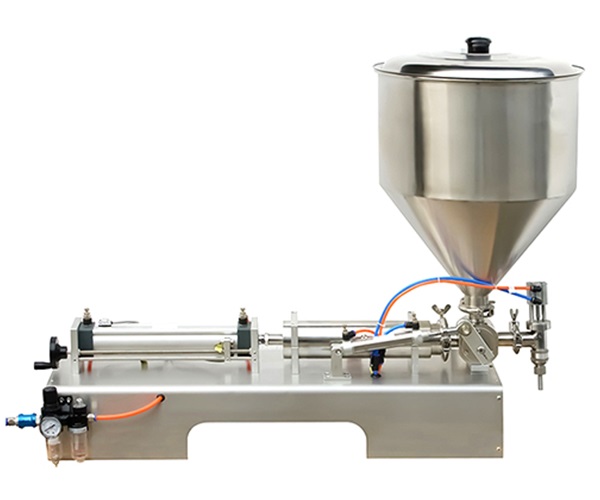
A nut butter filling machine of this type is a piston filler designed for thick pastes. An operator places the jar under the nozzle and starts filling with a foot pedal or automatic switch. The machine measures the product with a precision piston, then pushes it into the jar.
Here is how the piston system works:
- Material feeding — Peanut butter flows from the hopper into the valve body by gravity.
- Piston suction — The piston pulls back inside the cylinder and draws an exact volume of product through a three-way valve.
- Precise measurement — The cylinder stroke controls the volume, and a hand wheel adjusts the filling amount.
- Filling — The piston pushes forward and forces peanut butter through the nozzle into the jar.
This paste filling machine design is simple, reliable, and easy to maintain. That is why it is the most popular choice for small and medium producers.
Question 1: How Accurate Is a Semi-Automatic Peanut Butter Filling Machine?
Our peanut butter filling machine achieves ±0.5% to ±1% filling accuracy. For a 200-gram jar, the fill weight stays within about 1 to 2 grams of the target.
This is much stricter than most national labeling standards, which often allow 3% or more deviation. It also protects your profit. If you overfill by 5 grams per jar, you lose 2.5% of your product. At scale, that loss pays for a new machine within months.
Several factors affect paste filling machine accuracy:
- Air pressure stability — Unstable air causes inconsistent piston strokes.
- Material uniformity — Peanut butter must be smooth, without separation or large solids.
- Filling speed — Faster filling slightly reduces accuracy.
- Sealing ring condition — A worn ring causes leakage and volume loss.
Practical tip: Check the first ten jars of each batch with a digital scale. Adjust the hand wheel if needed. This takes two minutes and prevents costly recalls.
Question 2: Can a Nut Butter Filling Machine Handle Crunchy Peanut Butter?
This is the most important limitation for any nut butter filling machine buyer.
Our semi-automatic filler works well with smooth, flowable products: smooth peanut butter, sesame paste, almond butter, cashew butter, sunflower seed butter, tomato sauce, and butter.
It cannot fill sticky crunchy peanut butter with low flow ability. Solid particles block the valve and nozzle, and the piston cannot draw the product reliably.
If you produce crunchy peanut butter, you have three options:
- Ask about a larger valve and nozzle setup for particle-containing pastes.
- Choose a screw pump paste filling machine for very thick products.
- Fill crunchy butter into larger containers where flow resistance matters less.
Always send a product sample to the manufacturer before buying. A five-minute flow test prevents a costly mistake.
Question 3: Will Peanut Butter Separate in the Hopper of a Paste Filling Machine?
Separation depends on your production pattern and product type.
Our standard peanut butter filling machine has a hopper without a stirrer. If you fill for 30 minutes, natural peanut butter usually stays mixed. If product sits in the hopper for hours, oil may rise and solids may settle.
Here are three solutions for your peanut butter packaging equipment:
- Fill in short batches and stir the product before loading.
- Choose a model with a stirred hopper for natural, unstabilized butter.
- Add a mixing tank before the filler in a larger line, with a pump feeding the hopper.
For small producers in Africa and other developing markets, the standard hopper is usually enough. Plan filling sessions so product does not sit for long periods.
Question 4: How Fast Is a Semi-Automatic Peanut Butter Filling Machine?
The machine fills 10 to 30 bottles per minute, depending on operator skill, jar size, and speed setting.
This semi-automatic filling machine requires the operator to place each jar under the nozzle. Speed is adjustable: slow it down for accuracy or speed it up for output.
| Production Scenario | Bottles per Minute | Bottles per 8-Hour Day |
|---|---|---|
| Careful operation, large jars | 10 | 4,800 |
| Normal operation, medium jars | 20 | 9,600 |
| Skilled operator, small jars | 30 | 14,400 |
Even at the slowest rate, one peanut butter filling machine replaces several manual workers. It also produces consistent, professional jars that support a higher retail price.
Question 5: Is a Nut Butter Filling Machine Easy to Clean?
Yes. This is one of the strongest practical advantages of our paste filling machine.
All food-contact parts are made of 316# stainless steel, fully in line with GMP standards. The valve body, hopper, three-way joint, and cylinder use quick-connection fittings, so you can take them apart without tools.
Cleaning steps for your peanut butter packaging equipment:
- Shut off air and power.
- Remove the hopper and valve body.
- Wash all contact parts with food-safe cleaner.
- Rinse and dry fully before reassembly.
- Wipe the body with a damp cloth. Never wash electrical controls with water.
This quick-clean design matters when you switch between peanut butter, sesame paste, and other products. It reduces cross-contamination and flavor mixing.
Question 6: What Is the Main Wear Part of a Peanut Butter Filling Machine?
The piston sealing ring in the cylinder is the main wear part of this semi-automatic peanut butter filling machine.
It stops peanut butter from leaking out of the rear of the cylinder. When the ring wears out, you will see product leaking from the back. Replace the ring at that point.
There is no fixed replacement interval. Service life depends on viscosity, particle content, filling frequency, cleaning habits, and air pressure stability.
Recommended practice for your nut butter filling machine:
- Check the ring every 3 to 6 months if you fill thick or particle-containing pastes.
- Keep spare sealing rings in stock to avoid downtime.
- Do not open the cylinder or add lubricant yourself. The cylinder is pre-lubricated at the factory. Contact after-sales support for guidance.
This is a low-cost part. Replacing it on schedule costs far less than losing a day of production.
Question 7: What Support Comes with a Peanut Butter Filling Machine?
Our peanut butter filling machine comes with a one-year quality guarantee. We cover faults caused by machine quality or manufacturing defects.
The warranty does not cover:
- Damage from operation mistakes or man-made problems.
- Electrical damage from voltage fluctuation, phase shortage, or faulty wiring.
We also provide:
- An operation manual with installation, adjustment, and troubleshooting steps.
- Video guidance for setup and maintenance.
- Spare parts, including sealing rings and nozzles.
- Remote support by phone, WhatsApp, or email.
For buyers in Africa and other regions, we arrange shipping and document support. Ask for a spare parts package with your peanut butter packaging equipment order so you never stop production for a missing part.
Semi-Automatic vs Fully Automatic Peanut Butter Filling Machine
| Factor | Semi-Automatic Filler | Fully Automatic Filler |
|---|---|---|
| Investment | Low | High |
| Labor | 1 operator | Minimal labor |
| Capacity | 10-30 bottles/min | 60+ bottles/min |
| Flexibility | Easy to change jars and products | Needs changeover setup |
| Best for | Startups and small factories | Large factories |
If you are starting a peanut butter business, a semi-automatic peanut butter filling machine is the right first step. It keeps investment low while delivering professional results. When demand grows, add conveyors, a capping machine, and a labeling machine to build a fuller peanut butter packaging equipment line.
Key Specifications of a Nut Butter Filling Machine
| Parameter | Specification |
|---|---|
| Type | Semi-automatic piston paste filling machine |
| Filling range | 100 ml – 1000 ml |
| Filling accuracy | ±0.5% to ±1% |
| Filling speed | 10-30 bottles per minute |
| Air pressure | 0.4-0.6 MPa |
| Power | 50W, single phase, 220-240V |
| Contact material | 316# stainless steel |
| Machine size | 1000 × 300 × 600 mm |
| Weight | 28 kg |
| Main wear part | Piston sealing ring |
Final Checklist Before Buying a Peanut Butter Filling Machine
Before you order a semi-automatic peanut butter filling machine, confirm these points:
- Product type — Is your peanut butter smooth and flowable? Ask about other options if it is crunchy or very thick.
- Jar size — Confirm the filling range covers your smallest and largest containers.
- Target output — Estimate bottles per hour and compare with the 10-30 bottles/min range.
- Air supply — Confirm your compressor delivers 0.4-0.6 MPa at 30 L/min.
- Power supply — Confirm single-phase 220-240V power is available.
- Spare parts — Order extra sealing rings and a spare nozzle.
- After-sales support — Confirm warranty terms and spare parts availability.
A nut butter filling machine is one of the best investments a small food producer can make. It improves accuracy, cuts waste, raises product presentation, and prepares your business for larger orders. Test with your own product, and keep spare parts ready.
Related Production

Get in touch
If you have any questions or just want to say hello, please don’t hesitate to contact us. We’ll get back to you soon.
Address
Xinhua Road, Economic-Technological Development Area, Lianyungang City, Jiangsu, China
Contact
Tel: +86 17513062090
WhatsApp: +86 17513062090
Email: info@peanutbuttermachien.com