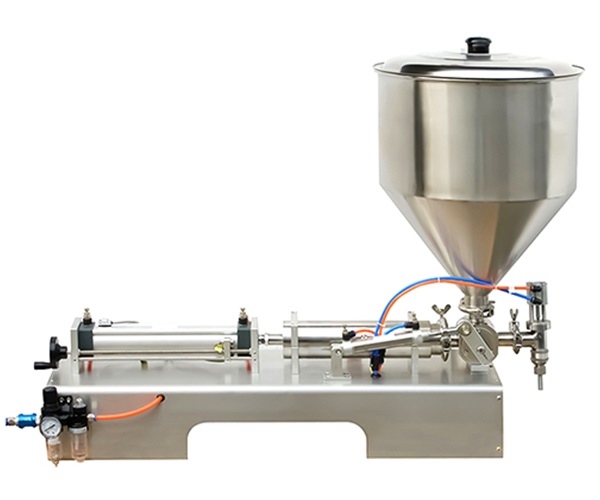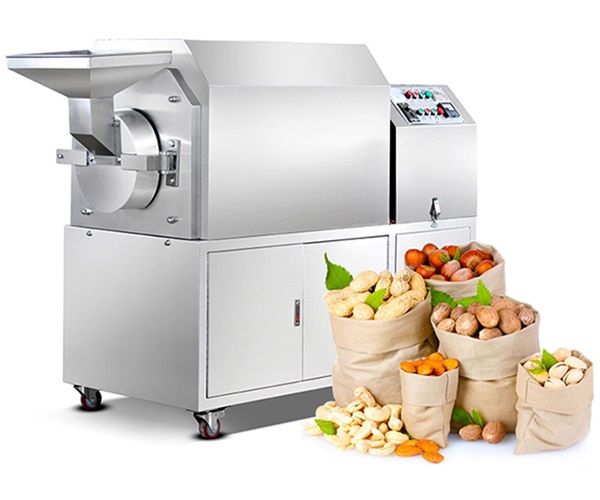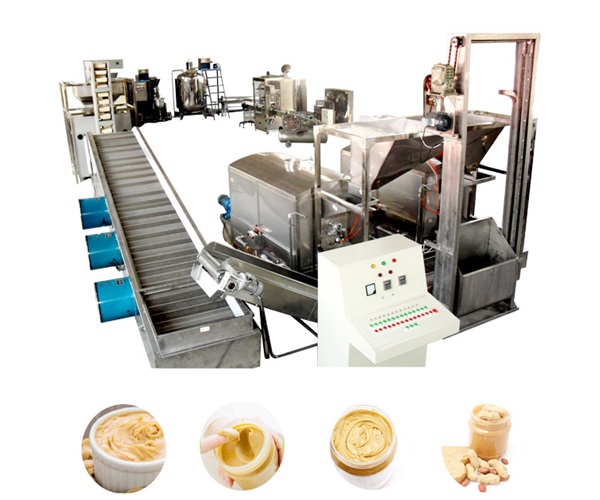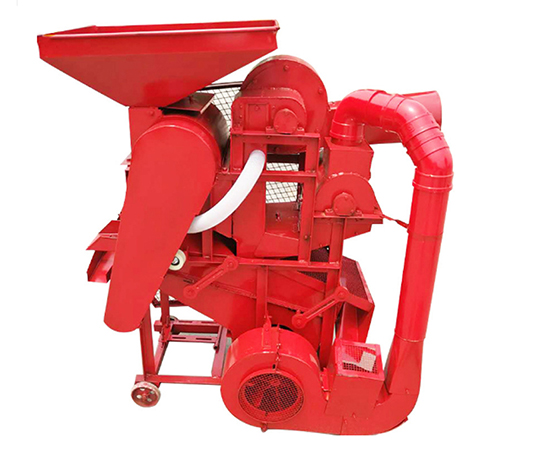

A peanut butter machine is a piece of equipment specifically designed for food processing, used to grind roasted peanuts, almonds, cashews, and other oil-rich nuts into smooth or chunky peanut butter. Choosing the right commercial nut grinder directly impacts the product’s texture, shelf life, and production costs. Below, we provide a detailed overview of the main types of peanut butter grinders, their technical specifications, and key decision-making criteria for buyers—ranging from small-batch artisans to large-scale manufacturers.
1. Main Types of Peanut Butter Machines
A. Stone Mills
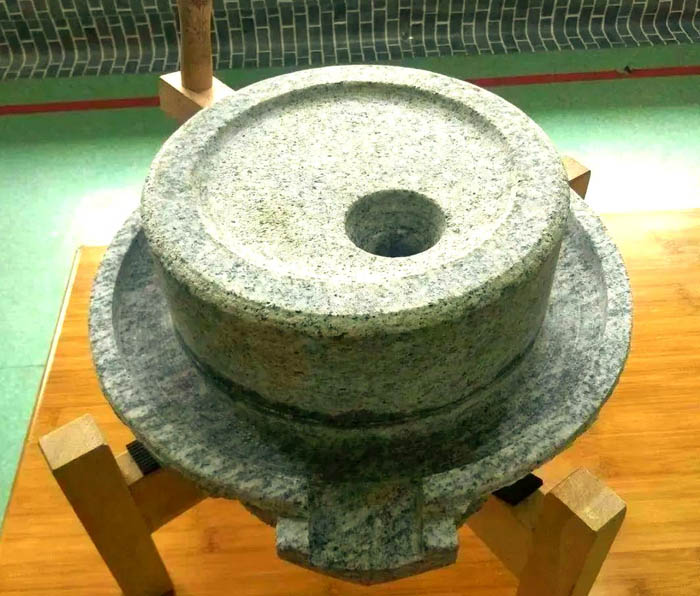
Two horizontally or vertically mounted natural granite or engineered emery stones. The upper stone rotates at a low speed (40–80 rpm), while the lower stone remains stationary. Peanuts are fed into the center; centrifugal force flings them outward through a gradually narrowing gap (0.5–2 mm).
- Fineness range: 80–150 mesh (equivalent to 180–100 micrometers). The D90 value typically achieved is approximately 120 micrometers.
- Best Texture Outcome: Slightly gritty, rustic mouthfeel, retaining visible peanut particles – preferred for “artisan” or “old-fashioned” labels.
- Best uses: Artisanal producers, organic product lines, and formulations requiring minimal heating (below 60°C to preserve nutrients).
B. Vertical Peanut Butter Machine
A vertically mounted motor directly drives the rotor-stator assembly, which features multiple rows of concentric, precision-cut teeth or serrated discs. Rotational speed: 2,800–7,200 rpm. The material enters from the top, passes through the gap (adjustable via a handwheel from 0.01 mm to 3 mm), and is discharged from the bottom under high centrifugal pressure.
- Fineness range: 150–200+ mesh (75–100 microns). The high-end D90 model achieves a particle size of ≤50 micrometers, producing ultra-smooth peanut butter comparable to supermarket brands.
- Best Texture Outcome: Velvety, homogeneous paste with no detectable grit – ideal for fillings, spreads, and confectionery coatings.
- Best use: Small- to medium-sized factories producing smooth, spreadable peanut butter for retail or candy fillings.
C. Split-Type Peanut Butter Machine (Belt-Driven Colloid Mill)
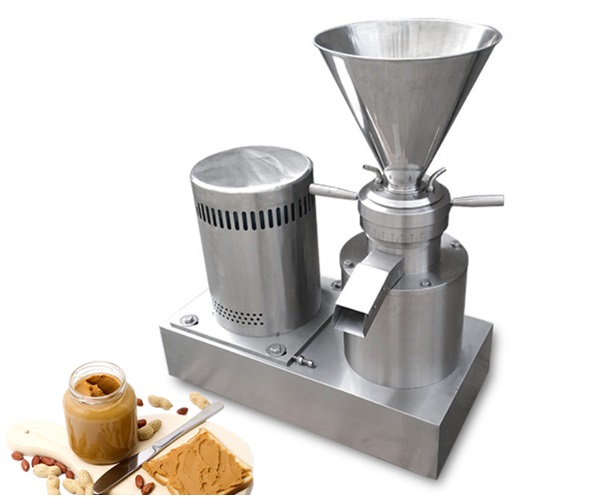
The motor and grinding chamber are physically separated and connected via a V-belt and pulleys. The grinding rotor is mounted on a separate, heavy-duty bearing housing with a cast-iron base. The rotational speed can be adjusted by changing the pulley diameter (typical spindle speed: 1,500–3,600 rpm).
- Fineness range: 120–180 mesh (80–120 microns). Suitable for producing both smooth and crunchy textures (requires an auxiliary nut feeder to handle lumpy nuts).
- Best Texture Outcome: Versatile—low-speed grinding mimics the smooth texture of a vertical mill, while wide-gap grinding mimics the coarse texture of a stone mill.
- Best suited for: High-humidity environments; viscous nut butters containing added sugar or honey; and large-scale producers prioritizing ease of maintenance over compactness.
2. Suitability – Personal / Small-Batch vs. Industrial / Commercial
| User Profile | Recommended Type | Rationale |
|---|---|---|
| Home user / Hobbyist (1–5 kg per batch) | Mini stone mill (≤ 1.5 kW) | Low cost, simple operation, no water-cooling required. Accepts small quantities without waste. Manual cleaning is straightforward. Fineness is adequate for household palates. |
| Café / Restaurant / Small bakery (5–50 kg/day) | Vertical disc mill (3–7.5 kW) | Consistent daily output, compact footprint (≈ 0.5 m²), and ability to produce café-quality smooth butter. Built-in water cooling prevents overheating during peak hours. Quick gap adjustment allows switching from almond to cashew in 2 minutes. |
| Artisan producer / Farmers’ market (20–100 kg/day, premium niche) | Stone mill with auger feeder | The distinctive rustic texture commands higher prices. Low shear preserves volatile aromas – a marketing advantage. Requires skilled operator for stone maintenance. |
| Medium-scale factory (200–1,500 kg/day) | Vertical disc mill (15–30 kW) with dual cooling zones | High throughput, automated gap control, and CIP-friendly design. Achieves D90 ≤ 50 µm consistently for 8-hour shifts. Best return on investment (ROI) for private-label brands. |
| Large industrial line (> 2,000 kg/day, humid environment) | Split belt-driven mill (37–55 kW) | Motor isolation prevents water damage from steam cleaning. Belt drive allows speed tuning for different nut oil contents (e.g., 42% for peanuts vs. 55% for macadamias). Modular design enables quick stator/rotor replacement (≤ 20 minutes) without dismantling the motor. |
| Multi-product facility (nuts + seeds + cocoa liquor) | Split mill with variable-speed pulley | The same unit can grind peanuts, sunflower seeds, and even cocoa nibs by changing gap and speed. Belt slippage acts as a mechanical fuse – protects the motor if hard foreign objects (e.g., unremoved shells) enter the chamber. |
Please contact us via the quote request form or by calling our technical hotline. We will help you find the peanut butter machine best suited to your specific production needs—because the perfect grind is the difference between a good product and a market leader.